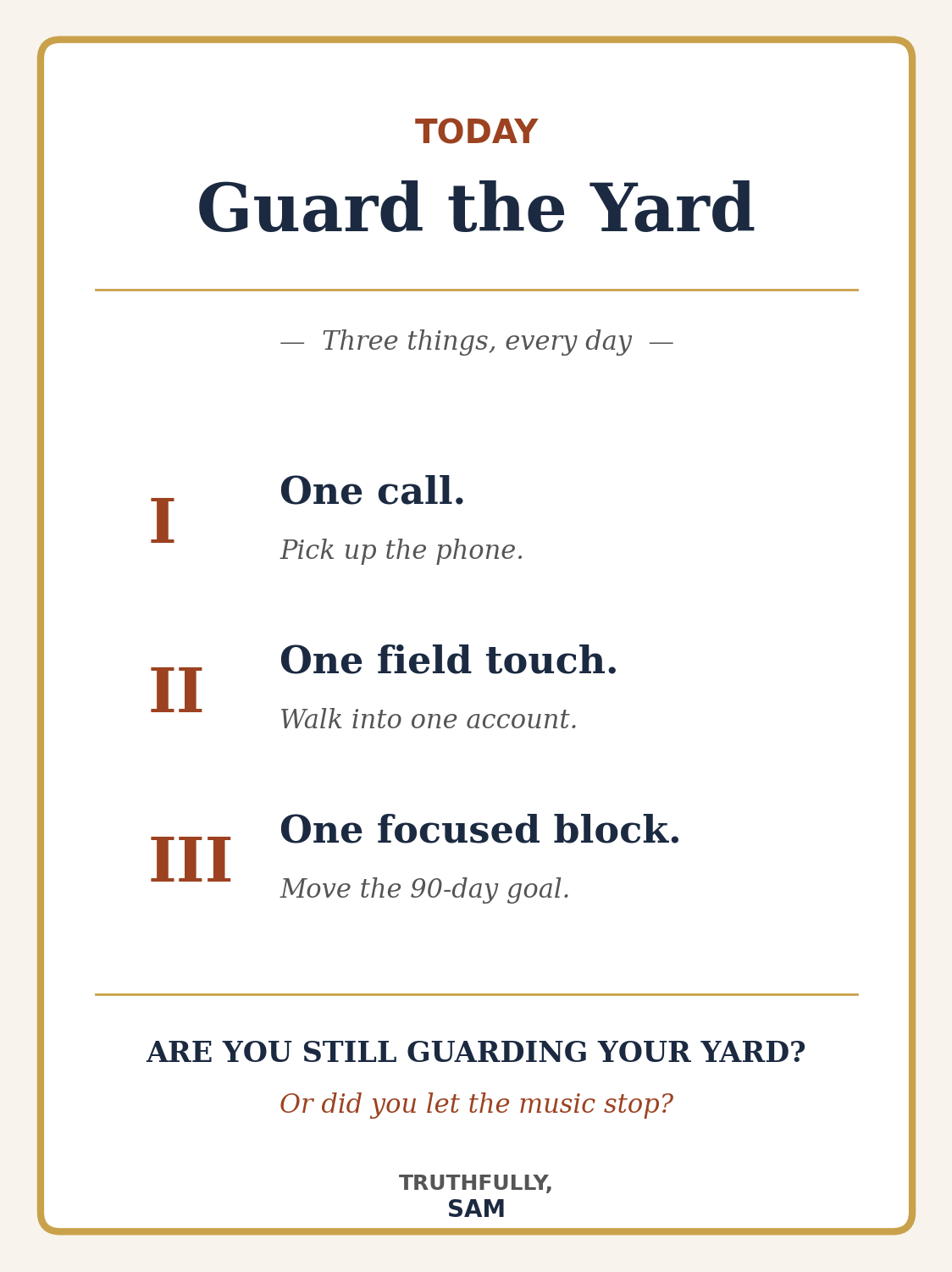
The Daily Action Card
BEVASSETS · FOUNDER'S PLAYBOOK
A Founder's Playbook for Building a Beverage Brand
From Pitch to Pour to Purchase
Forty years of operator-level truth
for the founder in month six who's wondering if it still matters.
A letter before the playbook begins
If you opened this playbook, you are probably tired. I am going to start there, because every other piece of advice I have ever given a beverage founder begins with that fact — and the ones that pretend otherwise are written by people who have never sat in the truck.
You believed in the brand on a Tuesday night two years ago. You believed in it when your spouse asked how much longer. You believed in it through the first "we'll take a look" that turned into a "not right now." You believed in it through the placements that didn't reorder, the chain meetings that got rescheduled three times, and the contract that came in with terms you almost couldn't agree to but signed anyway because you needed the volume.
Now you are somewhere around month six, or month sixteen, or month sixty. The pace has shifted. The music in the room has gotten quieter. The yard you used to guard with both ears up has gotten harder to see, and the founders you started with have started disappearing — some sold for parts, some folded, some just got tired and walked away. You are still here, but you are not as sure as you were on day one.
I have been in this business for more than forty years. I have ridden routes in every region of this country. I have sat in distributor general manager offices and waited for the meeting that wasn't going to go your way. I have watched founders win, and I have watched founders quit. I will tell you what I have come to believe: this playbook is not about strategy. Strategy is the easy part. This playbook is about the unglamorous middle — the part nobody writes about, the part where the brand is built or buried.
You don't have a brand because you have a contract. You have a brand because somebody on stop number 11 still believes your bottle is worth bringing up.
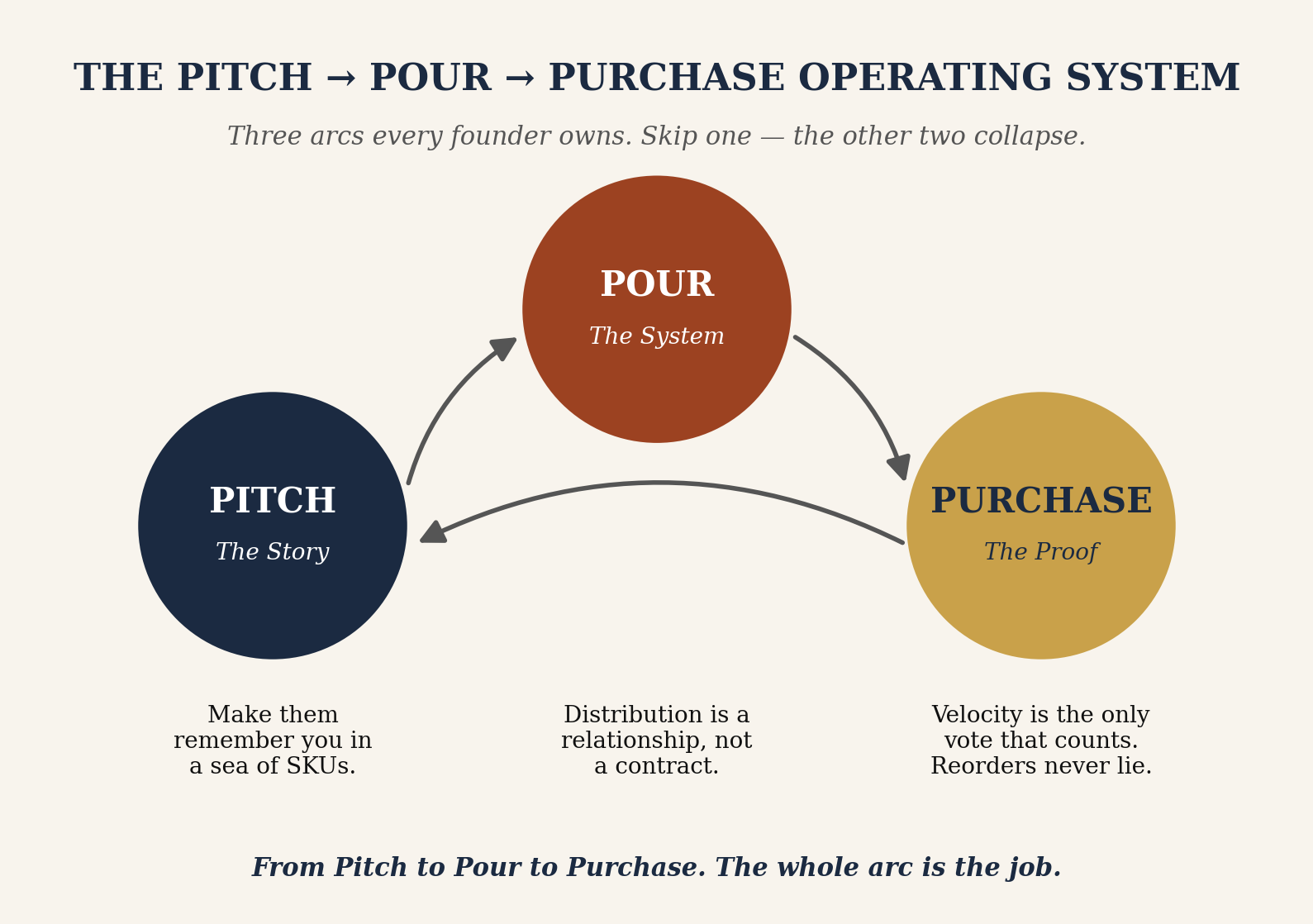
What follows is structured in four parts. Part I is the mindset — four principles that hold everything else up. Part II is the operating system — the Pitch → Pour → Purchase arc that every founder has to own end-to-end. Part III is the frameworks — four diagnostic tools you can run on Monday morning. Part IV is a ninety-day action plan you can start this week.
Read it slowly. Mark it up. Argue with parts of it. Then go pick up the phone.
Truthfully,
Sam
Before we begin
If you are coming to beverage alcohol from another industry — tech, CPG, hospitality, professional services — there are a few structural realities worth saying out loud before we go any further. None of this is meant to scare you. It is meant to make sure the rest of this playbook lands inside a real picture of the world you are building inside.
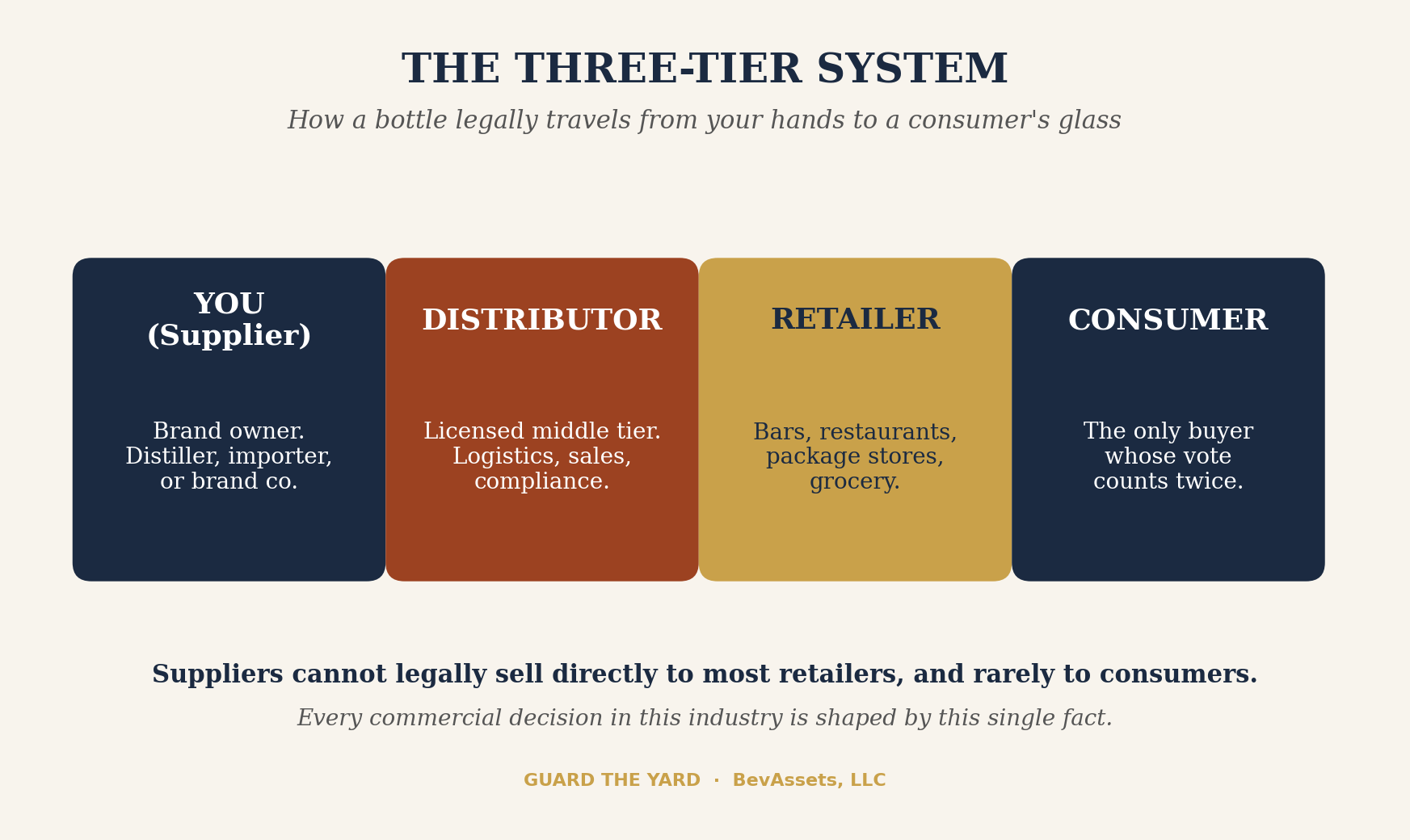
In the United States, alcohol moves through three legally separate tiers: suppliers (you), distributors (the middle), and retailers. With rare and tightly regulated exceptions, you cannot skip the middle. The distributor is not a logistics partner. The distributor is the only legal way most of your product gets to most of the people who will ever drink it. That structural fact shapes almost every decision in this book.
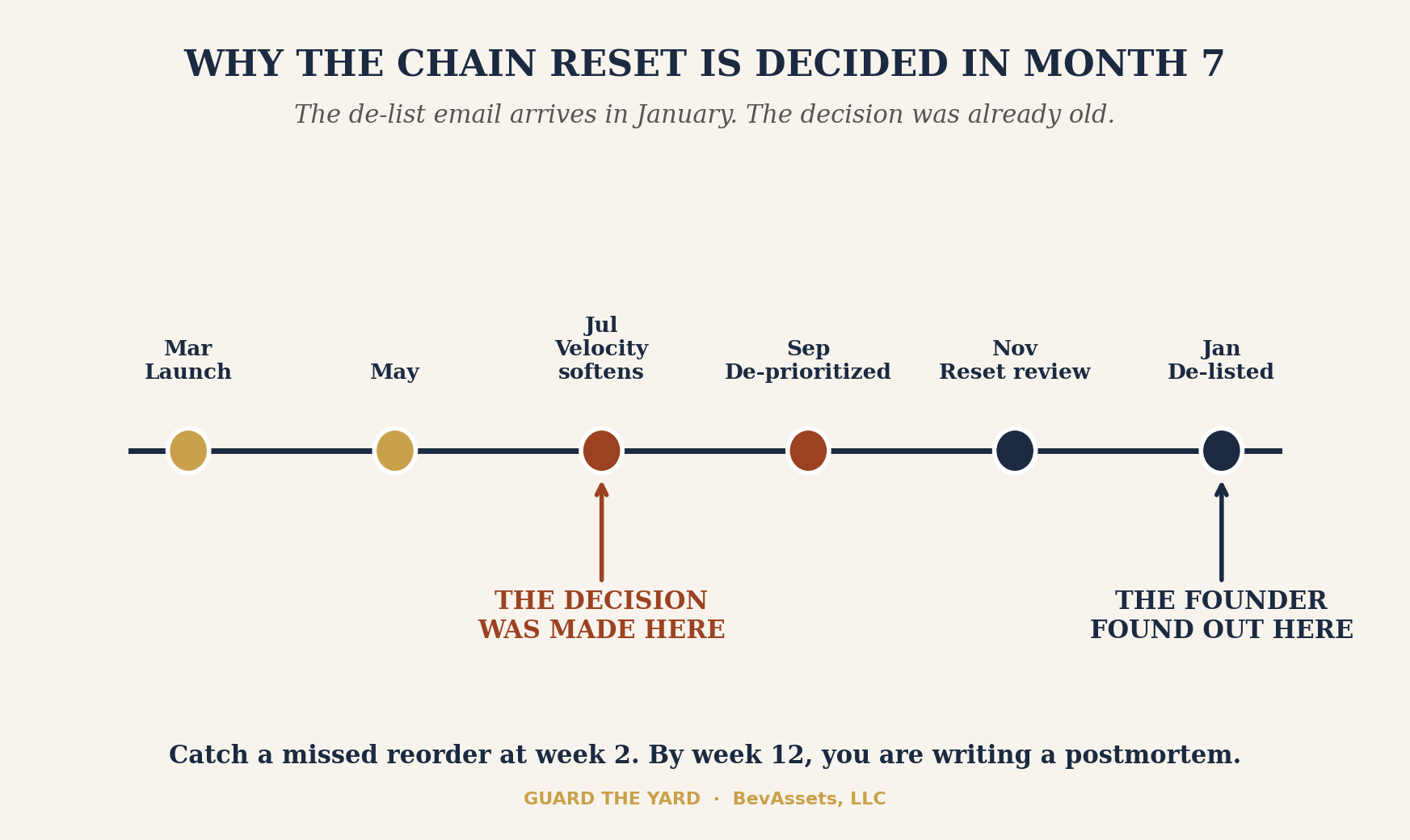
The single most important number in your business is depletion velocity — the rate at which your product moves out of distributor warehouses, through accounts, and into a consumer's hand. Placements without velocity look like progress on a press release and look like failure on a depletion report. Reorders are the only metric that does not lie. Most of this playbook is really about one thing: how to build a brand that earns the reorder.
Part I
Strategy is downstream of energy. I have watched dozens of brands with the better strategy lose to brands whose founders simply refused to be outworked. I have also watched brands with perfect strategy collapse at month nine because the founder ran out of fuel and there was nobody else who cared enough to keep guarding the yard.
Principle 1
Founder energy is the asset on the balance sheet that no one writes down.
I have a dog. Not a particularly heroic dog. A perfectly average dog, by most measures. But one morning that dog heard Crazy Train come on the radio and turned into a Marine. Planted at the fence. Ears up. Forty minutes guarding a yard that nobody was attacking. He did not know the threat was imaginary. He just knew the music said it was time to show up, and he showed up.
I have thought about that dog more times than I would like to admit, because I have seen exactly that energy in every founder I have respected in this industry — and I have seen exactly that energy disappear, slowly, in every founder I have watched lose.
Are you still guarding your yard, or did you let the music stop?
Principle 2
Winners build routines that carry them when motivation disappears.
I want to introduce you to another dog. His name is Pumpkin. Some of my best ideas in the last decade did not come from a boardroom or a strategy off-site. They came walking five miles with Pumpkin while the rest of the world was still asleep.
Pumpkin does not care about the algorithm. He does not care about quarterly depletion targets, or about the buyer who didn't call you back, or about whether the LinkedIn post got more engagement than the last one. He shows up every morning ready to move forward.
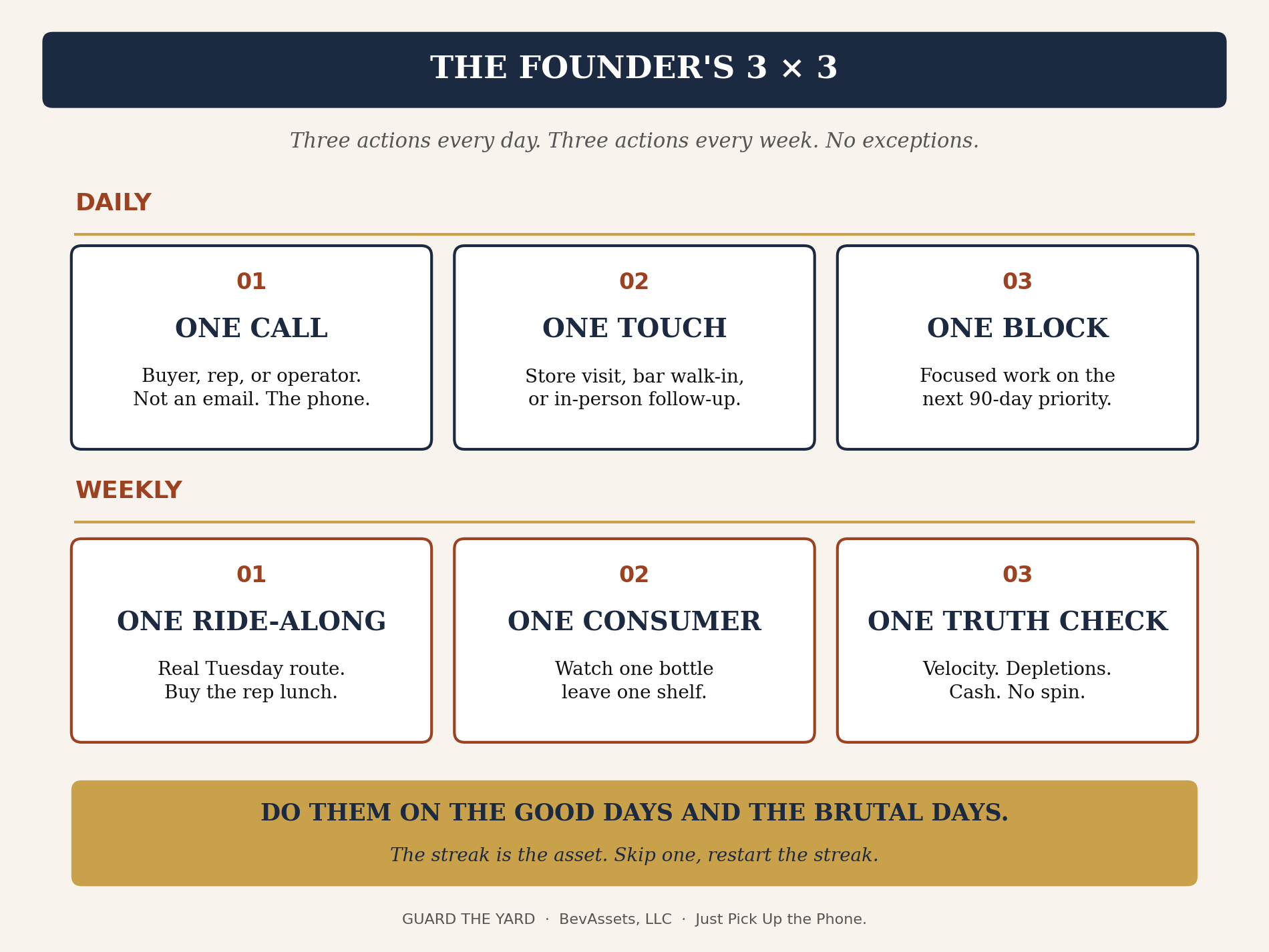
One walk. One call. One conversation. One more step. That is how momentum gets built.
Principle 3
Because there is no other way that works.
Victor Harvey spent twenty years building Victor George Brands the hard way. Started in nightclubs. Ended up in a distillery. There were no shortcuts in those twenty years. There never are.
If your plan is built on becoming the next brand that came out of nowhere, your plan is built on a fiction. The brands that came out of nowhere came from somewhere — they came from a founder who decided, early on, that the hard way was the only way that worked, and then did the hard way every day for years.
Hard is not the obstacle. Hard is the path.
Principle 4
Especially to yourself.
My signoff on every LinkedIn post is "Truthfully, Sam." It is not a marketing choice. It is an instruction. The fastest, most reliable way to kill a beverage brand is to lie to yourself about its numbers, and the most common failure mode I see in this industry is a founder who has been quietly lying to themselves for eighteen months and has now run out of cash because reality was never invited into the conversation.
Hope is not a strategy. Hope is what you have when you don't have distribution.
Part II
There are three arcs in every beverage brand's life, and a founder must own all three. Most founders are great at one of them. The great ones learn to be at least good at all three. Pitch is the story. Pour is the system. Purchase is the proof.
Chapter 1
The American beverage alcohol market launched somewhere in the neighborhood of eight thousand new SKUs last year. Most of them will not be in market three years from now. Most of them died because the brand never gave the people in the system a reason to remember it. So the first job of the pitch is not to be liked. The first job of the pitch is to be remembered.
A real pitch is not a deck. A real pitch is a single sentence that a tired distributor rep can repeat to a tired buyer on a Tuesday afternoon without looking at notes.
This brand is _____. We are the only one that _____. It will sell because _____.
Chapter 2
Most new founders think a signed distributor contract is distribution. It is not. A signed contract is permission to potentially have distribution. Distribution itself happens later, on a Tuesday morning, when a rep is driving between accounts and decides whether your brand is one of the three he is going to lead with on his route today.
A founder called me last week to ask how to know if his distributor was actually selling his brand. I told him the only thing that works:
Ride with the rep for one day. Not the polished ride-along the GM schedules. A real one.
You will learn more in eight hours than you have learned in the previous year of reading depletion reports. The data is in the truck. The reports are downstream.
Chapter 3
You can have the prettiest bottle in the cooler. You can have the deepest distribution in the state. None of it matters if the bottle does not move. Velocity is the only vote that counts. Reorders are the only metric in this business that has no spin attached to it.
If the reorder isn't there in 90 days, you don't have a customer. You had a courtesy.
Part III
Four diagnostic tools. Short on purpose. Founders do not need more theory — they need diagnostics they can run on a Monday morning, get a real answer from, and act on by Wednesday.
Score these five questions honestly when you get home from a real ride-along, before your internal narrative softens the data.
Q1. Did the rep mention my brand without being prompted?
0Q2. Did the buyer recognize the brand name?
0Q3. Did the rep know my pricing, programs, and POS correctly?
0Q4. Did anyone in the back room know my brand?
0Q5. Did my bottle stay in the bag through stop 11?
0Move the sliders to see your verdict.
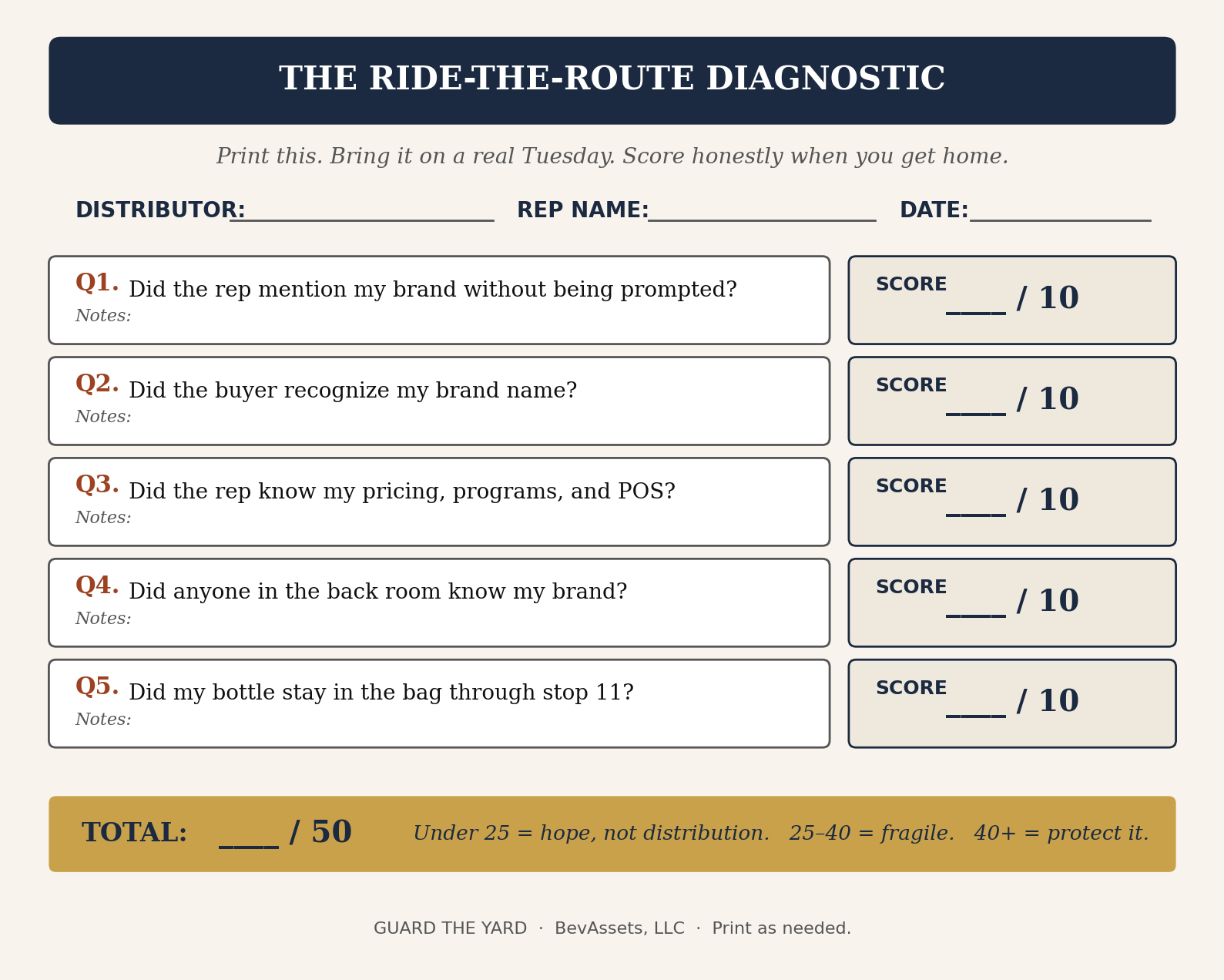
Five questions to answer with numbers, not feelings. If any answer is "I don't know," you have a knowing-what-is-happening problem first.
Run this on the first of every month, starting at month four. Honest answers only.
If you answer no to two of those, the music has stopped. Turn it back on. Today.
My tagline ends with four words: Just Pick Up the Phone. Email is comfortable. Slack is comfortable. The phone is uncomfortable — and that is exactly why it works.
The founder who picks up the phone has an unfair advantage in an industry where everyone else has stopped using theirs.
Part IV
Run this plan starting Monday. Three thirty-day blocks. Each one has a single intention. The sequence matters.
Days 1–30
Replace the dashboard you wish you had with the dashboard you actually have.
Days 31–60
Replace assumptions with ride-alongs.
Days 61–90
Replace placements with reorders.
A little fun
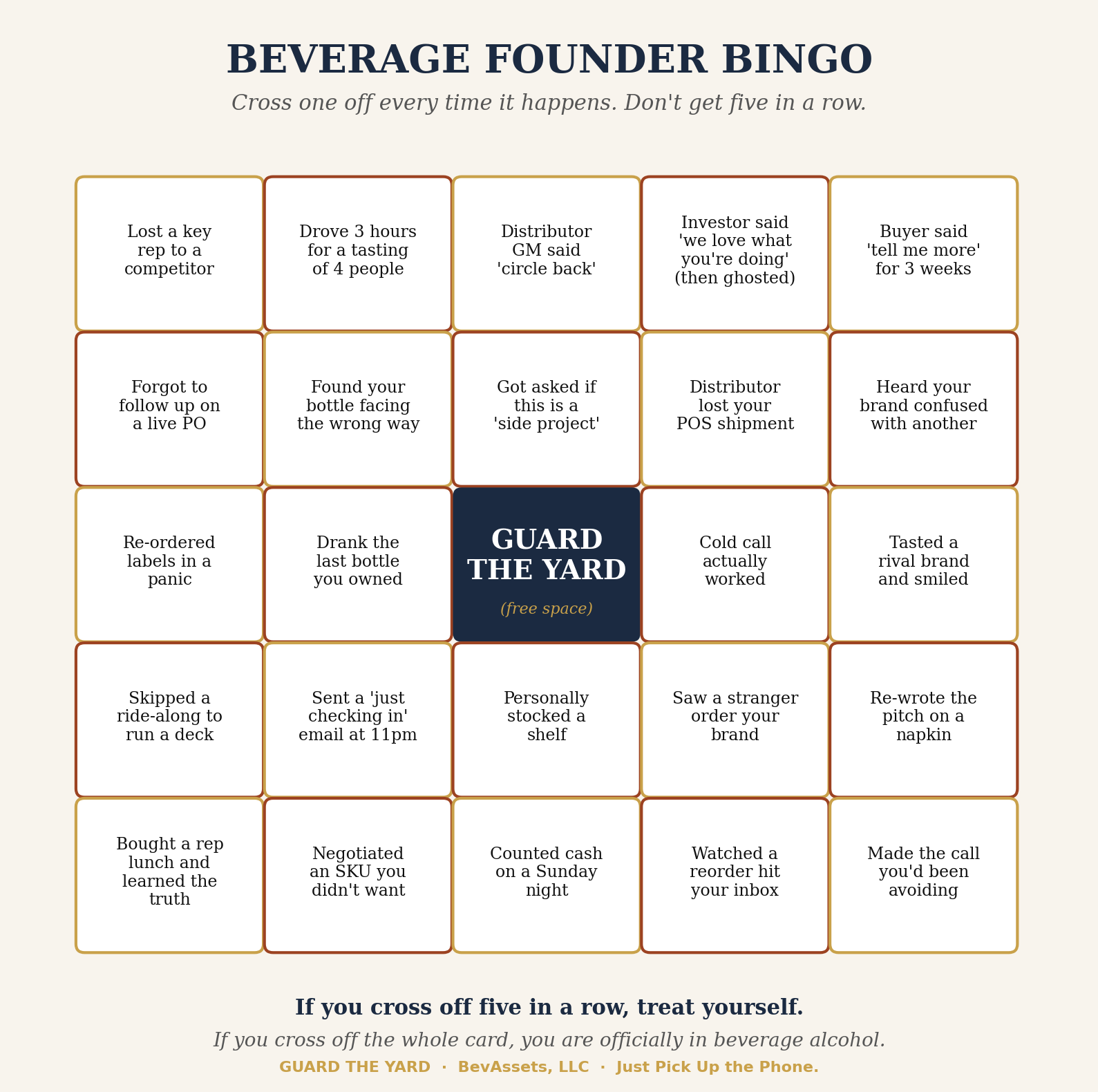
Some of this work is genuinely hard. Some of it is genuinely ridiculous. Both can be true on the same Tuesday. Click a square every time the moment happens to you. Try not to get five in a row. If you do, treat yourself.
No squares crossed yet.
Resources
Print the cards. Save the links. Steal the scripts. None of it works if it stays on the page.
LISTEN
DRINK UP Podcast — weekly conversations with founders, distributors, operators.
READ
DrinkUp Daily Industry Brief, Wine & Spirits Daily, IWSR data, Beverage Dynamics, BevNET.
CALL
BevAssets, LLC — when you need a second opinion from somebody who has ridden the route.
BevAssets exists because most founders need an operator in the truck with them, not a consultant in a slide deck behind them. We help beverage brands move from pitch to pour to purchase: distributor strategy, customer strategy, field activation, and the unglamorous blocking and tackling that turns placements into reorders.
Closing
If you are reading this last page, you have already done more than most of the founders who started when you did. Most of them quit reading playbooks somewhere around month four. Most of them quit guarding the yard around month six. You are still here. That is not nothing. In this business, that is the whole game.
The brands that win are not built by people for whom it was easier. They are built by people who decided, on a hard Tuesday, that the music was still playing and the yard was still worth guarding — and then went back to the fence one more time.
Are you still guarding your yard? Or did you let the music stop?
The music is still playing. Get back to the fence. Pick up the phone. Ride the route. Buy the rep lunch. Watch the bottle leave the shelf. Earn the reorder. Tell the truth. Do it again tomorrow.
Crush it.
Truthfully,
Sam